How to Receive SMS Online for Free to China Virtual Phone Number
China’s digital ecosystem is vast and increasingly walled — platforms from WeChat and Weibo to Taobao and JD.com require local +86 phone numbers for account registration, and most reject international numbers outright. receive-sms.io provides free access to Chinese virtual phone numbers, letting you receive SMS verification codes online without a China Mobile, China Unicom, or China Telecom SIM. Whether you’re accessing a Chinese platform from abroad or testing an app for the mainland market, this service gives you a working +86 number instantly.
Step 1: Select a Chinese Virtual Number (+86)
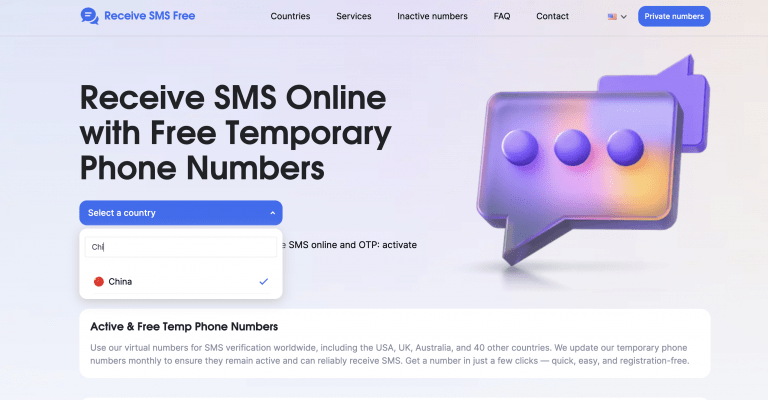
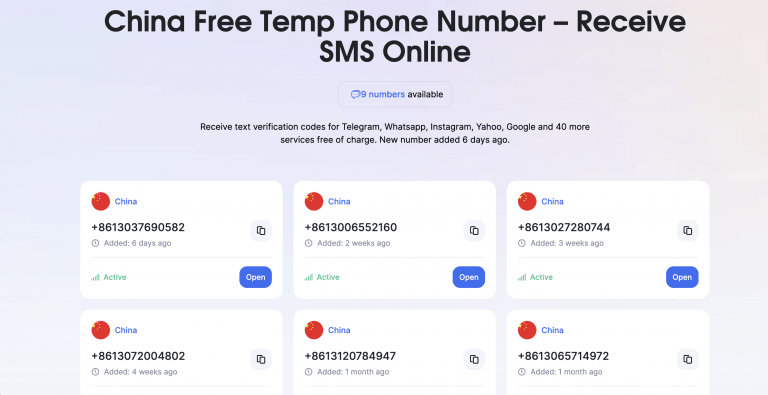
Go to receive-sms.io and open the China section — you’ll see a list of active +86 numbers available for immediate use.
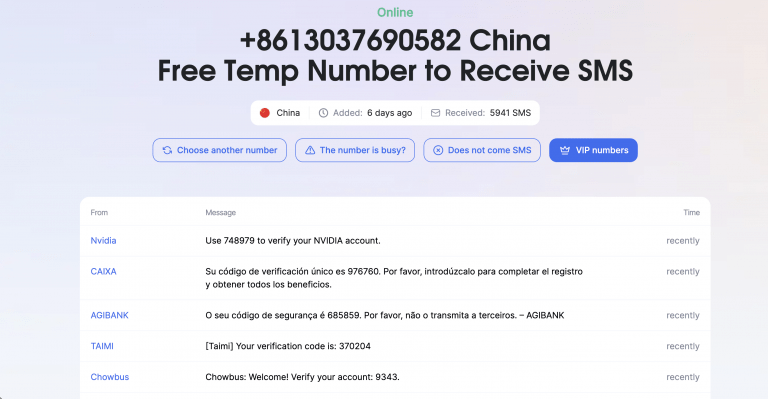
Pick a number and click into its inbox to verify it’s live and ready to receive messages.
Copy the +86 number in full — Chinese platforms often expect the number without the leading zero convention used domestically.
Step 2: Enter the +86 Number on Your Target Platform
Navigate to the Chinese platform or service requiring phone verification — WeChat, Weibo, Taobao, Xiaohongshu, Bilibili, or any other China-market app or website — and enter the +86 number in the registration field.
Request the SMS verification code; the platform will send a numeric code to the virtual inbox.
Step 3: Retrieve the Code and Activate Your Account
Return to receive-sms.io and reload the inbox page for the Chinese number you’re using.
SMS delivery from Chinese platforms can take 15–30 seconds depending on the originating carrier — refresh a couple of times if needed.
The incoming message will display in the inbox list with the code clearly readable.
Enter the code on the original platform to verify your account and complete registration.
Important Limitations for Chinese Numbers
China’s real-name registration law (实名制) means many platforms cross-check numbers against carrier identity records — some services may reject unregistered virtual numbers for full account activation.
Alipay, WeChat Pay, and major Chinese fintech platforms require real SIM numbers linked to verified Chinese identity for financial features — virtual numbers may allow initial sign-up but not payment activation.
Chinese platforms are known to rotate their SMS sending infrastructure to combat virtual numbers — if a code doesn’t arrive, try a different +86 number from the list.
The inbox is public and visible to all visitors — never use it for accounts linked to financial or sensitive personal data.
Why Use a Free Chinese Virtual Number for SMS Verification?
Access Chinese Platforms That Block International Numbers
WeChat, Weibo, Douyin, and dozens of other Chinese platforms refuse to send verification codes to non-+86 numbers. A virtual Chinese number from receive-sms.io is the most practical solution for users outside mainland China who need to register.
Reach the World’s Largest Digital Market Without a Chinese SIM
Getting a real +86 number as a foreigner requires a Chinese passport or residence permit and physical presence at a carrier store. A virtual number bypasses all of that for platforms where full identity verification isn’t mandatory.
Test Chinese App SMS Flows From Any Location
Developers building apps that interface with Chinese platforms or send SMS to Chinese users need real +86 numbers to test delivery. Free virtual numbers from receive-sms.io make that possible without procuring mainland SIM cards.
Stay Anonymous When Exploring Chinese Digital Services
Signing up for Chinese apps with your real number creates a data trail across platforms that share user databases. A disposable +86 number limits your exposure to exactly the platform you’re signing up for.
Useful for China Watchers, Researchers, and Journalists
People who study China’s digital environment often need to create accounts on mainland platforms for research purposes. A free virtual +86 number removes one of the biggest technical barriers to doing so.
No China Mobile, Unicom, or Telecom Account Needed
Obtaining a Chinese carrier SIM outside of China is extremely difficult and typically requires visiting a mainland branch in person. Virtual numbers eliminate that logistical barrier for users who only need basic SMS verification.
Completely Free — No RMB or Foreign Payment Required
receive-sms.io’s Chinese virtual numbers are available at zero cost — no payment in any currency required. Access is immediate and unlimited for SMS verification purposes.
Works for Multiple Chinese Platform Sign-Ups
If you need to register on several different Chinese platforms — Weibo for social media, Taobao for shopping, Bilibili for content — you can use different virtual numbers for each, keeping your registrations cleanly separated.
FAQ
What is a temporary Chinese phone number and why is it difficult to get a real +86 number?
A temporary Chinese phone number is a real +86 virtual number accessible through receive-sms.io that receives SMS through an online inbox. Getting a genuine Chinese carrier SIM is extremely difficult from outside mainland China — China Mobile, China Unicom, and China Telecom require in-person registration with a Chinese passport or resident ID. A virtual +86 number bypasses those requirements entirely for platforms where basic SMS verification is sufficient.
Is there a free Chinese virtual number I can use to receive SMS online?
Yes. receive-sms.io provides Chinese +86 numbers at zero cost and with no registration. Open the China section of the site, select any active number to view its live inbox, copy the number, and use it for whatever platform requires Chinese phone verification. No Chinese ID, no carrier contract, and no payment in RMB or any currency is needed.
Which Chinese platforms work with a virtual +86 number from receive-sms.io?
Platforms that work with virtual numbers for basic registration include certain classifieds and information services, international apps that accept +86 for regional access, and some Chinese content platforms that don't enforce full real-name verification at sign-up. Platforms with mandatory real-name verification enforced by the 实名制 law — including WeChat, Weibo, Alipay, and Taobao — may require full carrier-SIM linkage to national identity for complete account activation.
What is China's real-name registration law and how does it affect virtual number use?
China's 实名制 (shí míng zhì) real-name registration requirement mandates that mobile phone numbers be registered with the holder's verified national identity. Major Chinese platforms must link user accounts to these verified numbers. While a virtual +86 number can receive an initial OTP, platforms enforcing full 实名制 compliance will eventually require the account to be linked to a carrier-registered, identity-verified Chinese number.
Can I use a disposable Chinese number to access Bilibili or Xiaohongshu from outside China?
Some international users have successfully used virtual +86 numbers for initial registration on platforms like Bilibili and Xiaohongshu at the sign-up stage. Whether it works depends on how strictly the platform validates the number at registration versus during ongoing use. Platforms regularly update their verification systems, so results can vary — switching to a different +86 number from the list can sometimes resolve validation failures.
How is a virtual Chinese number different from a non-VoIP Chinese number?
A non-VoIP Chinese number is a traditional mobile number issued by China Mobile, China Unicom, or China Telecom, registered in person with Chinese national ID and biometric verification. Virtual numbers on receive-sms.io route SMS through internet infrastructure. For basic SMS reception the functional result is often the same — the code arrives. The distinction matters on platforms enforcing 实名制, where only a carrier-registered number linked to verified Chinese identity will pass.
Can researchers or journalists use a Chinese online phone number to study Chinese platforms?
Yes, and this is a common legitimate use case. Academics, journalists, and digital researchers who need to create accounts on Chinese platforms face a significant barrier in obtaining real +86 numbers. A virtual Chinese number from receive-sms.io removes that barrier for platforms where basic SMS verification is sufficient, allowing researchers to register and study platform behaviour without mainland China carrier access.
Are Alipay or WeChat Pay compatible with a temporary Chinese number?
No. Alipay and WeChat Pay are financial services subject to People's Bank of China (PBoC) regulations that require verified identity linked to a carrier-registered Chinese number and a Chinese bank account. These services apply layered KYC checks that go far beyond basic SMS verification. A virtual +86 number may pass the initial OTP step but will not unlock payment features on either platform.
How quickly does an SMS arrive in a Chinese virtual inbox?
SMS delivery from Chinese platforms can take 15 to 45 seconds, occasionally longer, depending on the originating platform's SMS gateway and international routing. If a code hasn't arrived after 90 seconds, refreshing the inbox and trying a different +86 number from the list is the recommended approach.
What should I not use a free Chinese +86 number for?
Do not use temporary Chinese numbers for: WeChat account registration or WhatsApp (both block virtual numbers); Alipay, WeChat Pay, or any PBoC-regulated financial service; platforms requiring full 实名制 compliance; or any communication containing private or sensitive information. These are shared public inboxes — all incoming messages are visible to any visitor on the same number's page.